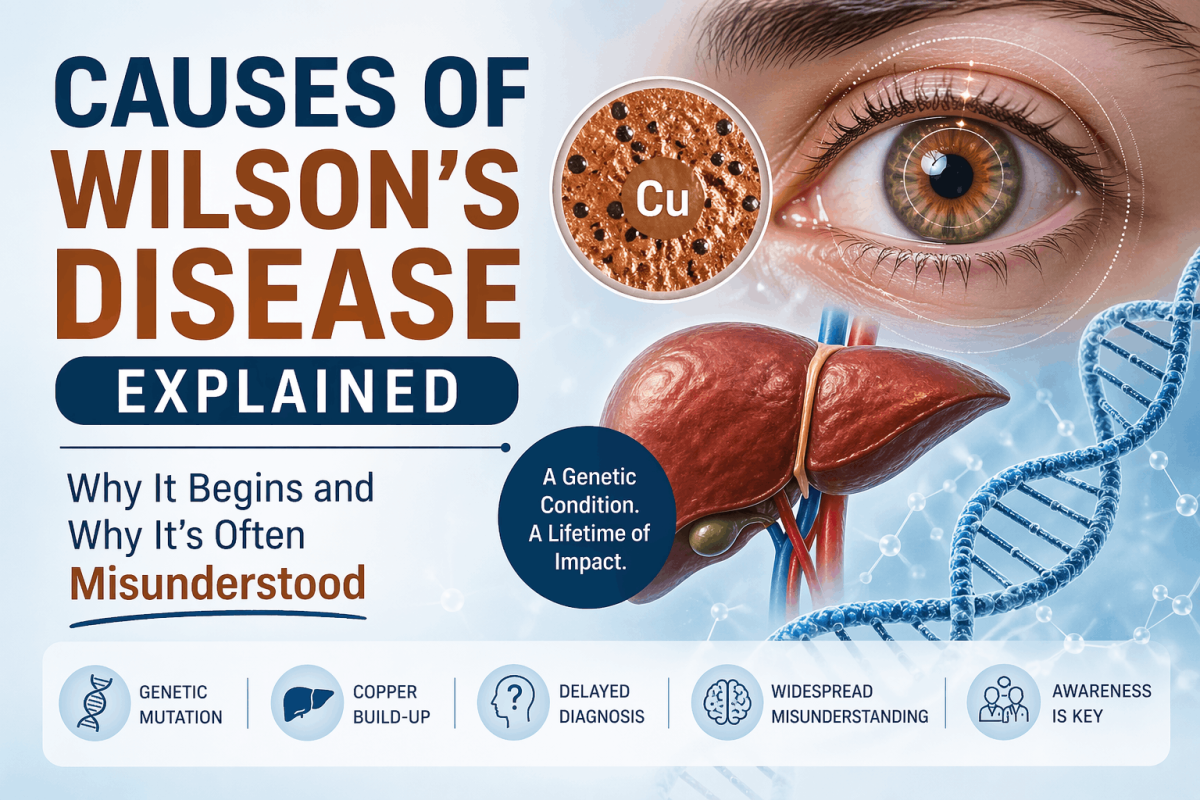
Why It Begins and Why It’s Often Misunderstood
If you try to trace Wilson’s disease back to its origin, you’ll find that it doesn’t begin with something visible. There is no infection, no injury, no lifestyle trigger you can point to and say, “this is where it started.”
It begins much earlier than that,quietly, at the genetic level.
But even that explanation, while technically correct, doesn’t fully answer what most people are trying to understand. Because the real question is not just what causes it, but why it stays hidden for so long and why it suddenly starts to matter after years of seeming normal.
When people look up Wilson disease causes, they’re often trying to make sense of a diagnosis that doesn’t fit the usual pattern. There’s a natural instinct to look for something external,diet, stress, environmental exposure. Something that could have been avoided.
And this is where Wilson’s disease feels different, sometimes even frustrating.
Because the cause is not something that develops over time. It is something that is already there.
The Genetic Origin, Present From the Beginning, Silent for Years
Wilson’s disease is linked to a mutation in a gene that regulates how copper is handled inside the body. This gene plays a role in transporting excess copper out of liver cells so that it can be excreted safely.
When this mechanism doesn’t function properly, copper doesn’t leave the body the way it should.
Now, what’s important here is not just the presence of this mutation, but how it behaves.
A person can carry this genetic change from birth and still go through years,sometimes more than a decade,without any noticeable health issues. Childhood may appear completely normal. Growth, energy levels, daily functioning,nothing stands out.
So from the outside, there is no indication that anything is wrong.
This creates a gap between cause and awareness. The condition exists, but it does not announce itself early.
And because there are no symptoms initially, there is no reason to look for it.
Copper Itself Is Not the Enemy
One of the most common misunderstandings around Wilson’s disease is the role of copper.
People often assume that the disease is caused by excess copper intake. That maybe diet plays a central role, or that avoiding certain foods could have prevented it.
That’s not how it works.
Copper is something the body needs. It is involved in essential biological processes,enzyme activity, energy metabolism, neurological function. The issue is not the presence of copper, but the inability to regulate it.
In a healthy system, copper is absorbed from food, used where required, and the excess is excreted through bile. It’s a controlled cycle.
In Wilson’s disease, that cycle breaks at the level of excretion.
So even normal dietary copper becomes a problem,not because there is too much of it, but because the body cannot eliminate the excess efficiently.
This is an important distinction, especially from an awareness perspective. The disease is not caused by what a person eats. It is caused by how their body processes what is already necessary.
Why Symptoms Take Time to Appear
This is where things get more complex, and also more interesting from a medical standpoint.
If copper is accumulating from an early age, why don’t symptoms show up immediately?
The answer lies in how adaptable the human body is.
The liver, which is the primary site of copper storage, has a significant capacity to absorb and manage excess copper,at least for a while. It doesn’t fail immediately. It compensates.
It stores more copper than it ideally should. It tries to maintain balance at a cellular level. It continues functioning even under increasing internal stress.
During this phase, there are no clear outward signs. No pain that demands attention. No obvious dysfunction.
This silent period can last for years.
But compensation has its limits.
Over time, as copper continues to accumulate, the liver’s ability to contain it starts weakening. And when that threshold is crossed, the excess copper begins to spill over into other parts of the body,particularly the brain.
This is when the disease starts shifting from a hidden process to a clinical condition.
Inheritance: Why It Appears in Some Families and Not Others
Wilson’s disease follows what is known as an autosomal recessive pattern of inheritance.
In simpler terms, a person needs to inherit the faulty gene from both parents to actually develop the condition.
Now here’s where it becomes a bit more nuanced.
Parents who carry one copy of the gene usually do not show symptoms. They are carriers, not affected individuals. So there may be no visible family history of the disease, even though the genetic possibility exists.
This is why Wilson’s disease can appear unexpectedly in a family.
Two carriers, completely healthy themselves, may have a child who develops the condition. And because there were no prior signs in the family, the diagnosis often comes as a surprise.
For siblings, the risk becomes relevant. If one child is diagnosed, others may need to be evaluated,not because they will definitely have it, but because the genetic probability exists.
From an awareness standpoint, this is important. The absence of family history does not rule it out.
Why the Cause Is Often Discovered Late
One of the reasons Wilson disease causes are discussed so frequently only after diagnosis is because the condition rarely gives a reason to suspect it early.
There is no trigger event. No specific moment where something changes dramatically.
Instead, there is a slow buildup.
The cause,genetic mutation leading to impaired copper excretion,is constant from the beginning. But its impact unfolds gradually, almost quietly, until it reaches a point where the body can no longer compensate.
By the time symptoms appear, the cause has already been active for years.
This gap between origin and recognition is what makes Wilson’s disease particularly challenging,not just to diagnose, but to understand from a patient’s perspective.
Because when symptoms finally show up, they feel recent. But the cause is not.
Why the Same Cause Doesn’t Look the Same in Everyone
One thing that often confuses people after understanding the cause is this:if the genetic issue is the same, why don’t all patients look the same clinically?
Why does one person develop liver-related problems early, while another shows neurological symptoms first? Why does the age of onset vary so much?
The answer isn’t always straightforward.
Even though the underlying cause,impaired copper excretion due to a genetic mutation,is consistent, the way the body responds to that defect is not identical in every individual. There are variations in how much residual function the gene still has. In some cases, it may not be completely inactive. In others, it may be more severely affected.
Then there’s the body’s own capacity to cope.
Some individuals are able to tolerate copper accumulation in the liver for longer before it begins to affect other systems. In others, the spillover happens earlier. The distribution of copper, the organs it effects first, and the rate at which symptoms develop,these can differ.
So while the cause remains the same, the expression of the disease can vary.
That’s why Wilson’s disease doesn’t follow a single predictable path. It has a pattern, but not a uniform one.
The Role of External Factors,What Matters and What Doesn’t
It’s natural to wonder whether external factors play a role.
Could diet accelerate the condition?
Could stress trigger it?
Could something have been done differently to delay or prevent it?
These are valid questions, especially when someone is trying to make sense of a diagnosis.
But in Wilson’s disease, external factors are not the root cause.
Dietary copper, for example, often becomes a point of concern. Foods like nuts, chocolate, shellfish,these are sometimes associated with copper content. But the disease is not caused by consuming these foods. A person without the genetic defect can handle dietary copper without any issue.
In someone with Wilson’s disease, dietary copper may contribute to the overall load, but it does not initiate the condition.
Similarly, stress or lifestyle factors may influence how symptoms are experienced or perceived, but they do not create the underlying metabolic problem.
This distinction matters, especially from an awareness perspective. It helps remove unnecessary guilt or confusion.
Wilson’s disease is not something that develops because of choices. It develops because of a biological limitation in handling copper.
What Actually Happens as Copper Continues to Accumulate
Once the liver’s capacity to store copper is exceeded, the situation changes.
Excess copper begins to enter the bloodstream and deposit in other organs. The brain is one of the primary sites affected at this stage, particularly areas involved in movement and behavioural regulation.
This is where the disease begins to shift from being a silent metabolic issue to something that produces visible symptoms.
Copper, in excess, is toxic to cells. It generates oxidative stress, damages cellular structures, and interferes with normal function. In the liver, this can lead to inflammation, scarring, and eventually more significant dysfunction if untreated.
In the brain, the effects are different but equally important. Instead of structural damage that is immediately visible, there is a gradual disruption of function,movement, coordination, emotional regulation.
What makes this phase challenging is that symptoms across different systems begin to overlap.
A person may have liver abnormalities and behavioural changes at the same time. Or neurological symptoms without severe liver complaints. The presentation doesn’t always follow a clean sequence.
And because the cause has been active for years, by this stage, the effects are already established.
Why Understanding the Cause Still Matters After Diagnosis
At first glance, it might seem like understanding the cause doesn’t change much,especially if the genetic mutation cannot be reversed.
But in Wilson’s disease, understanding the cause is directly linked to how the condition is managed.
Once it is clear that the problem lies in copper accumulation, treatment becomes focused and purposeful. It’s not about managing symptoms individually. It’s about reducing copper levels in the body and preventing further buildup.
This changes the entire approach.
Instead of treating liver abnormalities separately or addressing neurological symptoms in isolation, the focus shifts to the root mechanism. Medications are introduced to remove excess copper or reduce its absorption.
And because the cause is known, treatment is not temporary,it is long-term, often lifelong.
That can feel overwhelming at first, but it also provides clarity. There is a defined path forward.
The Importance of Recognising the Cause Early
Even though the genetic cause cannot be changed, the timing of diagnosis makes a significant difference.
If Wilson’s disease is identified early,before significant organ damage has occurred,treatment can prevent progression almost entirely. The liver can recover. Neurological symptoms, if mild, may improve or stabilise.
But if the condition is recognised later, after copper has already caused substantial damage, treatment becomes more about control than reversal.
That’s why awareness of Wilson disease causes is not just theoretical.
It helps people understand that the absence of symptoms does not always mean absence of disease. It highlights the importance of investigating unexplained liver abnormalities or neurological changes, especially in younger individuals.
And in families where a diagnosis has already been made, it becomes essential for early screening of siblings.
Because in this condition, knowing early changes everything.
Bringing It Back to What Needs to Be Understood
Wilson’s disease does not begin with something a person does. It begins with something the body cannot do properly.
The cause is quiet, constant, and present from the start. But its effects take time to surface.
That delay is what makes it difficult. It creates a gap between origin and awareness,a period where the disease exists, but doesn’t demand attention.
Understanding that gap is important.
Because once symptoms appear, it can feel sudden. But it isn’t. The process has been building for years.
And recognising that,recognising the nature of the cause,is what allows earlier diagnosis, better management, and in many cases, a much more controlled outcome.
